Altitude's Silent Influence: Adjusting Expectations for High-Elevation Encounters in South American Leagues
Frankie Müller · Jul 30, 2026
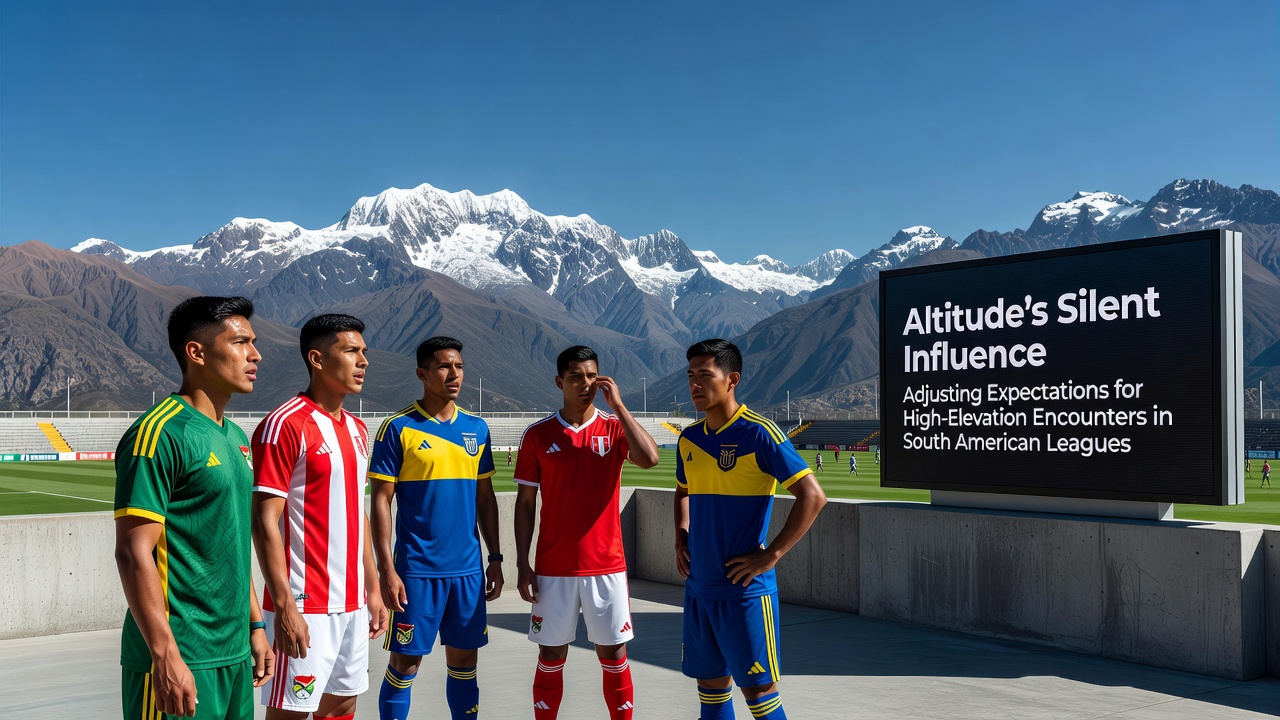
Altitude's Silent Influence: Adjusting Expectations for High-Elevation Encounters in South American Leagues
High-elevation venues across South America continue to shape match outcomes in ways that extend beyond standard performance metrics, with data from CONMEBOL competitions showing consistent patterns in player endurance and ball trajectory at altitudes above 2500 meters. Teams traveling from coastal regions to cities like La Paz or Quito encounter reduced oxygen availability that directly impacts aerobic capacity, while the thinner atmosphere alters how the ball travels through the air during passes and shots. Researchers from the National Institutes of Health have documented these physiological responses in elite athletes, noting measurable declines in sprint recovery times and decision-making speed after the first 30 minutes of play.
Physiological Demands at Elevation
Players experience a rapid drop in blood oxygen saturation when competing above 2800 meters, which forces the body to increase breathing rates and heart output just to maintain baseline effort levels. Studies tracking heart rate variability during Bolivian league matches reveal that visiting squads from lower elevations often see their effective work rate decline by 15 to 20 percent after halftime, whereas acclimatized home teams maintain steadier output throughout the second half. This difference becomes especially pronounced in matches scheduled during July 2026, when fixture congestion leaves limited recovery windows between games played at contrasting altitudes.
Ball Flight and Technical Adjustments
The reduced air density at high elevation changes how the ball behaves in flight, allowing it to travel farther and faster with the same striking force. Goalkeepers and defenders must recalibrate their positioning because shots that would normally curve or dip in thicker air maintain straighter trajectories, and long-range passes gain extra distance that can catch teams unprepared. Technical staff for clubs in the Ecuadorian Serie A routinely adjust training drills to simulate these conditions, emphasizing quicker reactions to through-balls that accelerate unexpectedly in the thinner atmosphere.
League-Specific Patterns in Bolivia, Ecuador and Peru
Bolivian Primera División fixtures at Hernando Siles stadium demonstrate the strongest home advantage in South American domestic competitions, with statistical reviews indicating that visiting sides convert fewer than 30 percent of their expected goal opportunities when playing at 3600 meters. Ecuadorian teams based in Quito benefit from a similar though slightly less extreme effect at roughly 2800 meters, where matches frequently produce lower total goals because both teams adopt more cautious pacing to manage fatigue. Peruvian clubs traveling to highland venues in the Liga 1 encounter comparable challenges, and analysts tracking 2025-2026 season data note that away sides average 12 percent fewer completed passes in the final third after the 60-minute mark.
Coaches have developed specific preparation protocols that include pre-match acclimatization camps lasting five to seven days, during which players gradually increase training intensity to stimulate red blood cell production. Some squads also incorporate portable oxygen tents during travel to maintain higher saturation levels before kickoff. These measures help narrow the performance gap, yet data from CONMEBOL Copa Libertadores encounters still shows that fully acclimatized home teams retain a measurable edge in both possession retention and defensive organization.
Historical Context and Recent Observations
International matches in the 2010s first brought widespread attention to altitude effects when FIFA considered regulatory changes for venues above 2500 meters, though no outright restrictions were ultimately imposed. Since then, national federations have collected more granular performance data that highlights how repeated exposure builds partial tolerance. During July 2026 qualifiers, several South American national teams reported using altitude simulation chambers in their domestic training bases to prepare for away fixtures in Bolivia and Ecuador, a practice that has become standard among professional setups seeking to mitigate the silent physiological toll.
Strategic Implications for Match Preparation
Teams that arrive only one day before kickoff tend to struggle more visibly with the combined demands of travel fatigue and oxygen deficit, while those that schedule longer stays show improved second-half metrics according to match-tracking technology. Midfielders and wide attackers bear the brunt of these conditions because their roles require sustained high-intensity running, leading many managers to rotate personnel earlier in high-altitude games. Defensive lines also shift deeper to compensate for reduced recovery speed, which in turn opens space for long balls that exploit the altered flight characteristics of the ball.
Conclusion
Altitude continues to function as an unstated variable in South American league encounters, influencing everything from individual player physiology to collective tactical choices. Clubs and federations that systematically account for these environmental factors through extended preparation and technical adaptation demonstrate measurable improvements in results at elevation. As fixture schedules intensify through 2026 and beyond, the capacity to adjust expectations and preparation around high-elevation venues remains a defining element of competitive planning across the continent.