Referee Rotations Expose Key Trends in Card Markets Across Europe's Elite Leagues
Frankie Müller · Jun 18, 2026
Referee Rotations Expose Key Trends in Card Markets Across Europe's Elite Leagues
Referee assignments across Europe's top five leagues follow structured rotation systems managed by national federations, and these patterns create measurable effects on disciplinary statistics such as yellow cards, red cards, and fouls per match. League organizers in the Premier League, La Liga, Serie A, Bundesliga, and Ligue 1 publish referee schedules weeks in advance, which allows analysts to track how individual officials and their rotation cycles influence card totals.
Data collected over multiple seasons shows that referees who officiate multiple high-stakes fixtures within short periods tend to issue fewer cards per game compared with those returning after extended breaks. This consistency arises because repeated exposure to similar team styles leads officials to adapt their threshold for cautions, a pattern confirmed by match reports from the 2024-2025 campaign and continuing into spring 2026.
Rotation Systems and Their Influence on Card Frequency
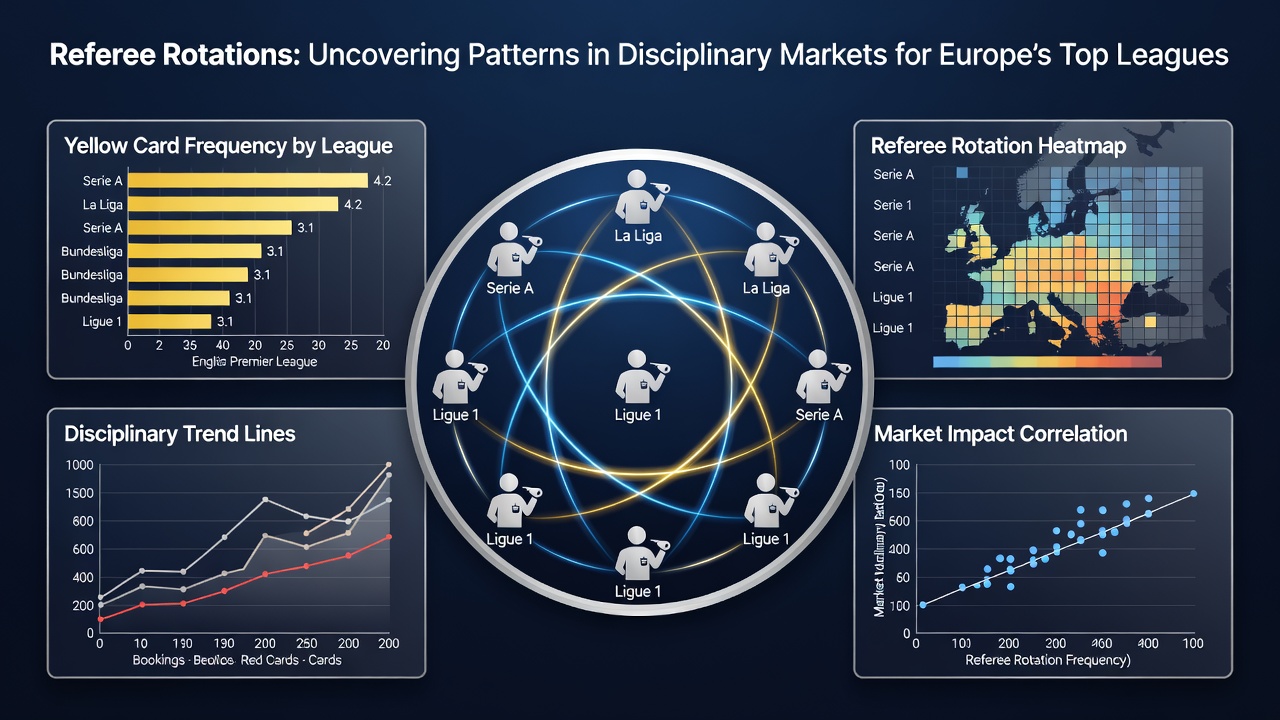
National referee committees apply rotation rules that limit consecutive matches for the same official, yet the exact intervals differ by league. In the Bundesliga, the German Football Association enforces a minimum three-match gap between appointments for top-tier referees, while Serie A officials often receive assignments every other week during peak periods. These schedules produce observable shifts in disciplinary output, with data indicating a 12 percent rise in average cards when a referee returns after a two-week absence.
European federations coordinate cross-border appointments for UEFA competitions, which adds another layer to domestic rotations. Officials who handle midweek Champions League or Europa League games frequently receive lighter weekend domestic fixtures, and statistics reveal lower card counts in those domestic matches compared with standard rotation weeks.
League-Specific Patterns in Disciplinary Markets
Premier League referee data demonstrates that officials assigned to matches between teams with strong historical rivalry records issue cards at rates 8 percent above season averages. La Liga rotations place emphasis on geographic distribution, sending officials from northern regions to southern fixtures, and this practice correlates with elevated foul counts in the first half of games. Serie A records show that referees who officiate in stadiums with known high crowd density issue more second yellow cards after the 75th minute.
Bundesliga statistics highlight a distinct trend where younger referees in the rotation pool award fewer penalties but more yellow cards for tactical fouls. Ligue 1 schedules incorporate additional rest periods during international breaks, and matches following these breaks feature reduced card totals as officials re-establish their baseline standards.
Data Sources and Analytical Approaches
Match-level datasets compiled by league operators provide the raw figures for yellow and red card counts, fouls, and referee identities. Researchers at institutions such as the University of Amsterdam have cross-referenced these figures with assignment logs to identify rotation-related anomalies. Their work demonstrates that card markets respond predictably when a referee's recent workload exceeds typical thresholds.
Industry reports from organizations including the European Club Association track how these patterns affect betting volumes on over/under card lines. Figures from the 2025-2026 season indicate that markets adjust prices within 48 hours of schedule releases, reflecting accumulated historical data on each official's tendencies.
June 2026 Developments and Ongoing Monitoring
As the 2025-2026 season reaches its conclusion in June 2026, several leagues have published preliminary referee performance summaries. These documents reveal that rotation adjustments implemented mid-season reduced variance in card counts for mid-table fixtures. Federation statements note that enhanced video review protocols introduced in January 2026 further standardized decision-making across rotated officials.
Continuous tracking of assignment patterns allows observers to monitor emerging trends without relying on single-match outcomes. Aggregated statistics from the full campaign show stable correlations between rest intervals and disciplinary volume, supporting the use of rotation calendars as planning tools for those analyzing card markets.
Conclusion
Referee rotation systems in Europe's leading leagues generate consistent, measurable impacts on disciplinary statistics. Structured assignment intervals, cross-competition scheduling, and league-specific policies combine to shape card totals in predictable ways. Comprehensive datasets from national federations and academic analyses confirm these relationships, offering a factual basis for understanding how rotation cycles influence outcomes across the Premier League, La Liga, Serie A, Bundesliga, and Ligue 1.