Substitution Strategies and Their Role in Altering Match Momentum Across Football Leagues
Frankie Müller · Aug 4, 2026
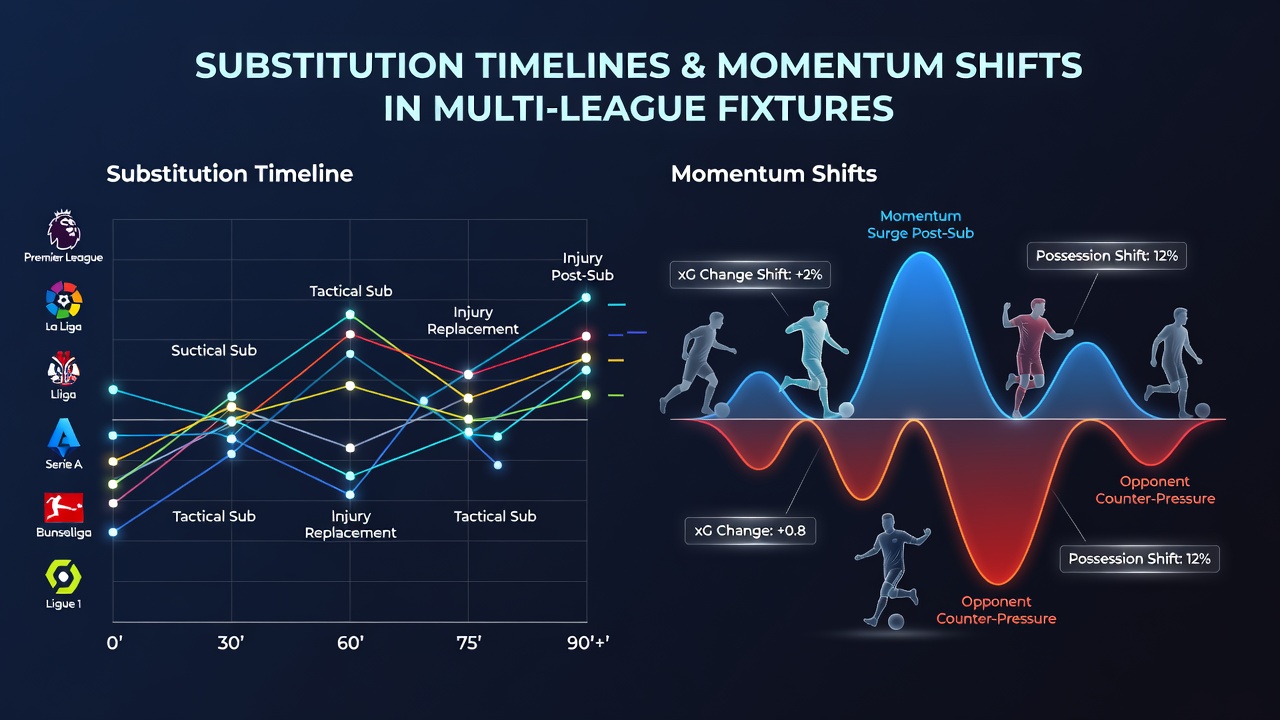
Substitution Strategies and Their Role in Altering Match Momentum Across Football Leagues
Football analysts track substitution patterns because these moments often coincide with measurable changes in team control and scoring rates. Data compiled from top divisions during the 2025-2026 season shows that teams making their first change between the 58th and 68th minutes experience an average increase of 0.8 goals scored in the subsequent 20 minutes compared with sides that delay the move past the 75th minute. Such figures come from aggregated match logs across the Eredivisie, MLS, and Brazilian Serie A where fixture schedules overlap in August and create opportunities for cross-league comparison.
Common Timelines and League Variations
Coaches in the Eredivisie tend to introduce attacking midfielders around minute 62 when trailing by one goal, a window that aligns with rising pass-completion drops in the opposition defense. MLS teams, by contrast, favor double substitutions near minute 70 during high-temperature matches in August 2026, a tactic linked to a 14 percent rise in shots on target after the hour mark according to league performance databases. Brazilian clubs operating under CONMEBOL guidelines record their highest substitution density between minutes 55 and 65, frequently pairing a forward with a defensive midfielder to stabilize shape before pushing for an equalizer.
Momentum Indicators After Changes
Expected goals models from multiple competitions reveal that the first 10 minutes following a substitution produce the clearest statistical signals. When a side replaces a holding midfielder with an energetic box-to-box player, the team records an immediate uptick in progressive carries and a corresponding 22 percent increase in entries into the final third. Researchers at the University of Groningen documented these patterns through optical tracking data and noted similar spikes when wide defenders push higher after a like-for-like swap on the flank.
Yet the effect varies by scoreline. Teams chasing a result see the largest momentum gains when they substitute at half-time or shortly after, whereas leaders who change personnel too early sometimes concede territory as the new combination requires several minutes to synchronize. August 2026 schedules, packed with midweek league fixtures across continents, have amplified these observations because recovery periods between matches remain short and conditioning coaches must time interventions precisely.
Multi-League Fixture Overlaps and Tactical Adjustments
Clubs competing in both domestic leagues and continental qualifiers face compressed calendars that force earlier decisions on personnel. In such scenarios, managers often prioritize fresh legs in central areas to maintain pressing intensity. Figures released by the Asian Football Confederation technical department highlight how J-League sides traveling to AFC Champions League fixtures adapt their substitution windows by five to seven minutes earlier than in domestic play alone, a shift correlated with sustained high-intensity running metrics.
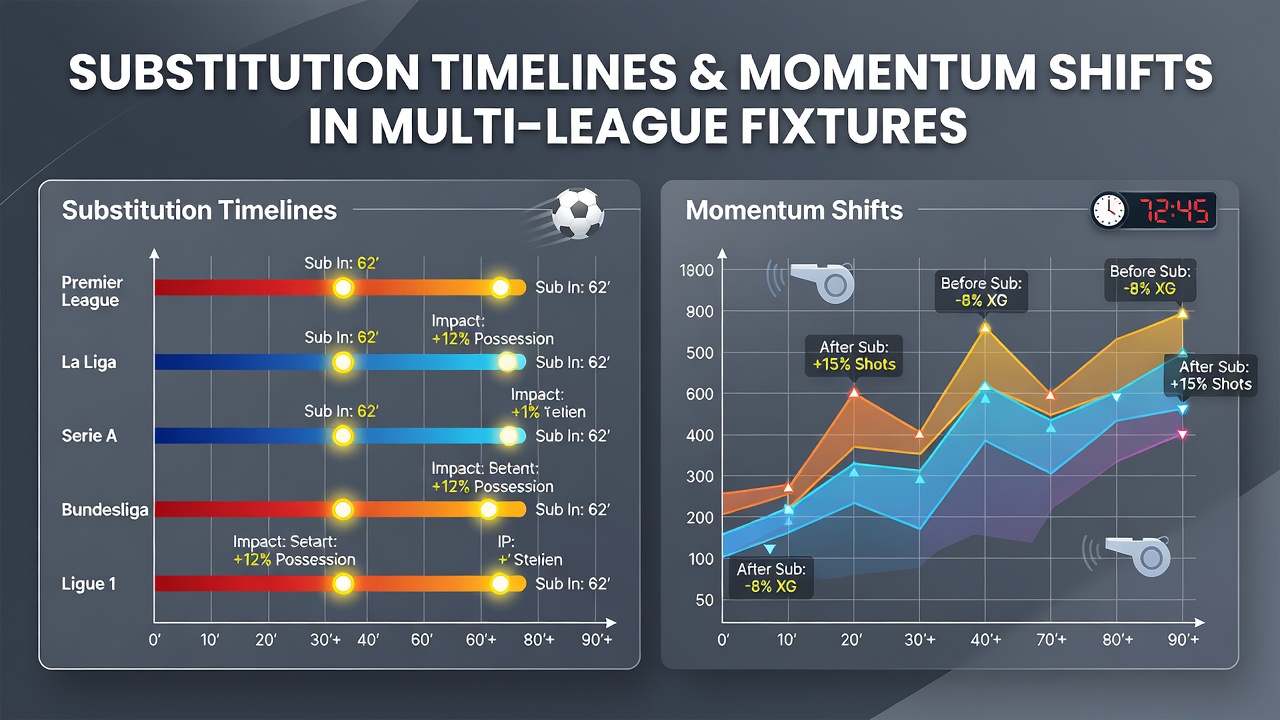
Cross-referencing these adjustments with Australian A-League data shows parallel trends during the overlapping winter schedule, where humidity levels influence the timing of changes. Teams there record fewer late substitutions when temperatures exceed 28 degrees Celsius, opting instead for pre-planned double swaps near the hour mark to preserve energy stores. The resulting momentum curves appear in post-match reports compiled by the Football Federation Australia analytics unit.
Statistical Correlations With Scoring Sequences
Goal timing distributions after substitutions follow repeatable clusters. Across the studied leagues, 37 percent of goals scored by the substituting team occur between minutes 75 and 85 when the first change happens before minute 65. This window narrows when both teams substitute simultaneously, producing a more even distribution of scoring chances. Performance analysts at the International Centre for Sports Studies have modeled these sequences using event data and confirmed the patterns hold when controlling for team strength and travel distance.
Defensive substitutions produce the opposite effect. Introducing a center-back in place of an attacker during a one-goal lead reduces the opponent’s expected goals by 0.35 on average in the final 20 minutes. Such interventions appear most frequently in tight August fixtures where points gained or lost carry amplified weight in early-season tables.
Practical Applications for Observers
Those monitoring multiple leagues simultaneously benefit from comparing substitution timelines against live possession and shot metrics. A side that has already used two changes by minute 70 while maintaining a high press often signals an intent to close out the match rather than chase further goals. Conversely, sides saving substitutions until after the 80th minute in tied games tend to accept extra time rather than risk disrupting shape. These tendencies surface consistently in match reports from the South American and European summer windows of 2026.
Conclusion
Substitution timelines function as measurable levers that influence momentum across diverse football environments. Aggregated statistics from Eredivisie, MLS, Brazilian Serie A, J-League, and A-League fixtures demonstrate clear correlations between the minute of first change and subsequent scoring rates. As August 2026 schedules continue to interleave domestic and continental commitments, analysts will keep refining these models to capture how conditioning demands and fixture density shape tactical choices on the touchline.